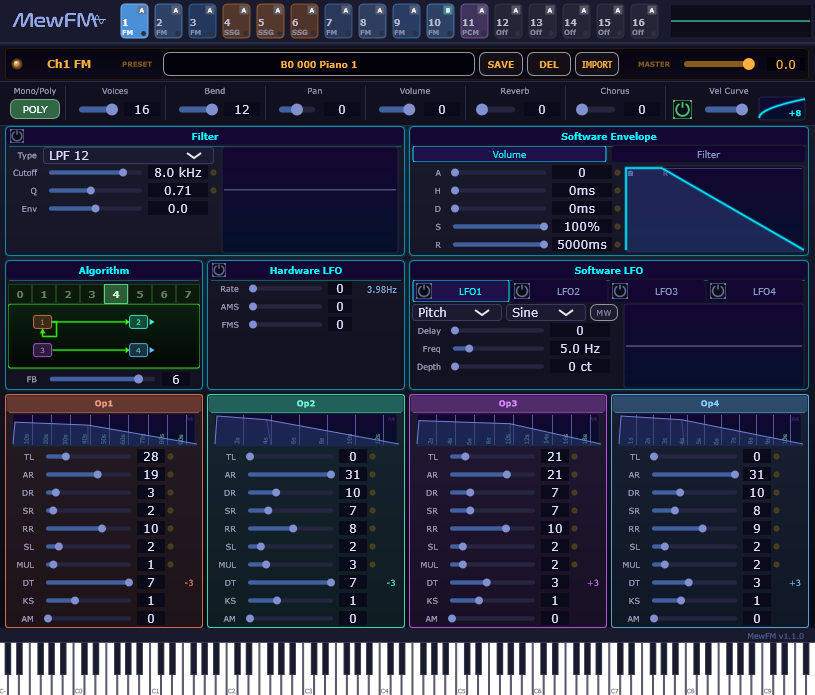
The FM section approximates the behavior of the YM2608’s FM unit (4 operators × 8 algorithms), with MewFM’s own extensions: a per-voice filter, SoftLFO, VelMap, and KeyMap.
4 operators and 8 algorithms
Each voice is built from four operators (OP1–OP4). Each operator has its own sine-wave generator and envelope. The algorithm number (0–7) determines which operator modulates which, and which operators go straight to the output.
Representative algorithms:
- ALG 0 (Series) —
OP1 → OP2 → OP3 → OP4 →, fully serial. Only OP4 reaches the output. - ALG 4 (2 pairs) — two parallel modulation pairs.
- ALG 7 (All parallel) — all operators go directly to the output — equivalent to additive synthesis.
Operators that go straight to the output are called carriers, and operators used for modulation are called modulators. OP1 has self-feedback (its strength is set with the FB parameter).
Operator parameters
| Parameter | Range | Role |
|---|---|---|
TL Total Level |
0–127 | OP output attenuation. For carriers this is volume; for modulators it is modulation depth. 0 = loudest, 127 = silent. |
AR Attack Rate |
0–31 | EG attack speed. 31 = instantaneous, 0 = very slow. |
DR Decay Rate |
0–31 | Decay speed down to SL. |
SR Sustain Rate |
0–31 | Further decay after SL is reached (0 = hold; otherwise = slow decay). |
RR Release Rate |
0–15 | Release speed after key-off. |
SL Sustain Level |
0–15 | Level at which DR transitions to SR (0 = high, 15 = low). |
MUL Multiplier |
0–15 | Multiplier on the base frequency. 0 = ×0.5, 1 = ×1, 2 = ×2 … 15 = ×15. |
DT Detune |
0–7 | 0/4 = none, 1–3 = +small/medium/large, 5–7 = -small/medium/large. |
KS Key Scale |
0–3 | How much the EG speeds up at higher pitches. 0 = off, 3 = max. |
AM AM Enable |
off/on | Whether LFO amplitude modulation is applied. |
Feedback / PMS / FMS / AMS
| Parameter | Range | Description |
|---|---|---|
| Feedback (FB) | 0–7 | Amount of OP1’s output fed back into OP1’s input. Used to add upper harmonics. |
| PMS / FMS | 0–7 | Depth of pitch modulation by the LFO. |
| AMS | 0–3 | Depth of amplitude modulation by the LFO (requires AM = on on the OP side). |
Sound design tips
To change loudness, move the carrier’s TL. To change timbre, move the modulator’s TL. The algorithm decides which operator is which (ALG 7 is all carriers — equivalent to additive synthesis).
If you want LFO-driven timbral motion, use the SoftLFO Op TL targets described later: targeting a modulator OP’s TL gives a “wah-like” timbre sweep.